Math Games for Kids: Free, Fun Ways to Build Number Skills
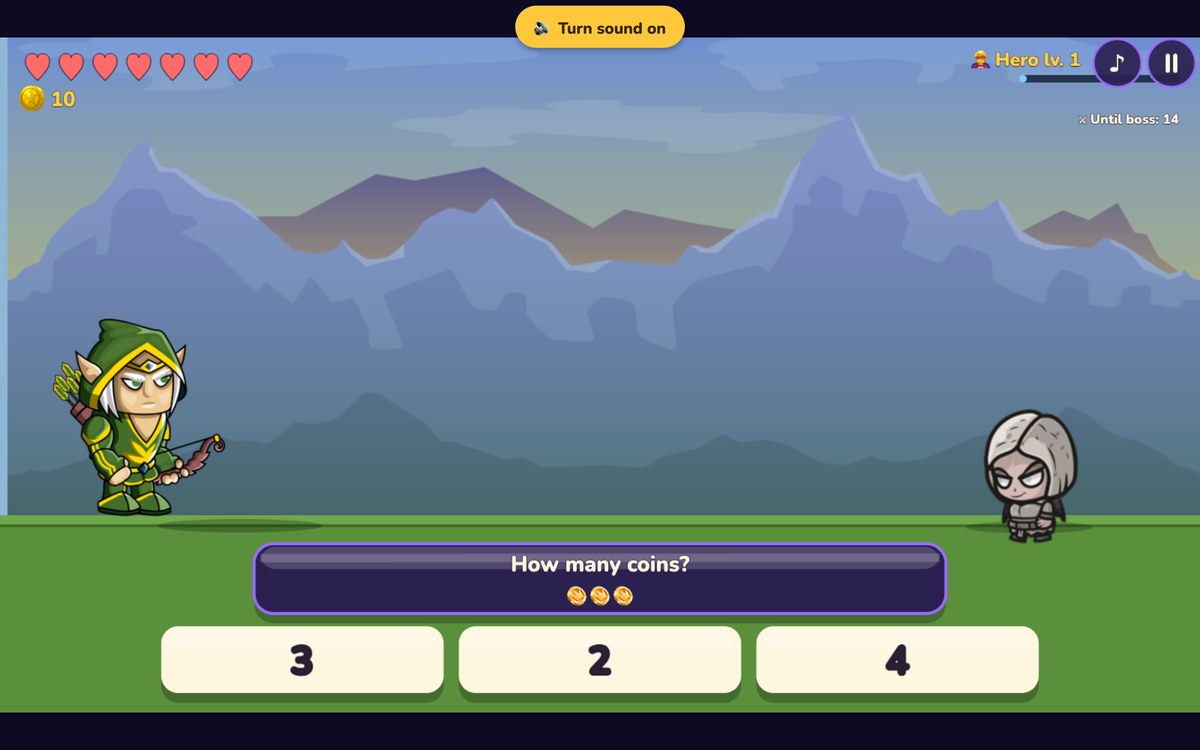
Our math games for kids turn the part of homework that usually brings groans into something children actually ask to do again. When a child is racing a clock, earning stars, or blasting the right answer out of the sky, they stop noticing they are practicing arithmetic at all. That is the whole idea: real fluency comes from repetition, and repetition only sticks when it feels like play. Everything here is free, runs straight in a browser, and is built around the skills kids meet in their school year.
What kids actually practice here
Math is a ladder, and each rung depends on the one below it. Our games are organized so children build confidence in order rather than jumping into something that frustrates them. Broadly, the progression looks like this:
- Number sense (ages 3-5): counting objects, recognizing digits 0-9, and comparing more vs. fewer.
- Addition and subtraction (ages 5-7): number bonds to 10, then to 20, with quick mental recall.
- Multiplication and times tables (ages 7-9): the heart of primary math, where speed really pays off.
- Division, fractions, and word problems (ages 9+): applying the basics to trickier, multi-step thinking.
A great place to start is Math Blaster, our fast-paced mental-math arcade game, which adapts to your child as they go and quietly nudges the difficulty up when they are ready for more.
Mastering the times tables, step by step
Times tables are where many kids either gain rock-solid confidence or quietly fall behind, so they deserve a smart order. We recommend the same path most teachers use: start with the 2s, 5s, and 10s, because their patterns are easy to spot and give kids an early win. From there, move to the 3s and 4s, then tackle the tougher trio of 6s, 7s, and 8s once the easier facts are automatic. Finish with the 9s (which have a lovely finger trick) and the 11s and 12s.
Why mixing it up matters
Once a single table feels solid, our games start interleaving facts from different tables. Jumping between 6 x 7 and 4 x 8 in the same session is harder than drilling one table in a row, but it is exactly this mixing that turns memorized lists into true recall a child can use in any order.
How to fit math games into a busy week
You do not need a long study session for this to work. Short and frequent beats long and rare almost every time.
The 10-minute rule
Aim for roughly ten focused minutes a day, four or five days a week, rather than one marathon on Sunday. Little and often keeps facts fresh and keeps your child from burning out. Because every game loads instantly with no download, it slips neatly into the gap before dinner or a car-ride wind-down.
Play alongside them
When you can, sit with your child for the first few rounds. Cheering a streak, asking "how did you work that out?", and celebrating mistakes as clues all turn a solo screen into shared time. Kids who feel watched in a warm way try harder and quit less.
Free, safe, and ready when you are
Every game on this hub is free to play, works on a phone, tablet, or computer, and needs no account to get started. We design for short, satisfying sessions so children leave feeling capable rather than drained. Browse by age or skill above, hand the device over, and let the practice feel like the reward it should be.
Games
Explore
The science behind the games
Every Dad4Kids game is built on one simple truth: children want to play, not study — so we turn learning into a game worth replaying. The method draws on peer-reviewed research in game-based learning, motivation, and how memory works.
- Tokac et al. (2019). Effects of game-based learning on students' mathematics achievement: A meta-analysis. Journal of Computer Assisted Learning.
- McLaren et al. (2017). A computer-based game that promotes mathematics learning more than a conventional approach. International Journal of Game-Based Learning.
- Deng et al. (2020). Digital game-based learning in a Shanghai primary-school mathematics class: a case study. Journal of Computer Assisted Learning.
- Alotaibi (2024). Game-based learning in early childhood education: a systematic review and meta-analysis. Frontiers in Psychology.
- Lampropoulos & Sidiropoulos (2024). Impact of gamification on students' learning outcomes and academic performance: a meta-analysis. Education Sciences.
- Taylor & Boyer (2019). Play-based learning: evidence-based research to improve children's learning experiences. Early Childhood Education Journal.
FAQ
Are math games good for kids?
Yes. Well-designed math games turn repetition into play, which is exactly what builds fast, accurate recall of number facts. The key is choosing games matched to your child's level so they feel challenged but not overwhelmed.
How do you make math fun for kids?
Keep sessions short (about ten minutes), tie practice to rewards like stars or streaks, and play alongside your child when you can. Letting them race a timer or 'beat' a previous score turns dry drills into a game they want to win.
What age should kids start math?
Informal math starts as early as ages 2-3 with counting, sorting, and comparing sizes. Structured number work like addition usually begins around ages 5-6, and times tables typically come into focus between ages 7 and 9.
What is the best order to learn times tables?
Start with the 2s, 5s, and 10s because their patterns are easy to see, then move to the 3s and 4s, then the harder 6s, 7s, and 8s, and finish with the 9s, 11s, and 12s. Mixing tables together once each is solid builds true recall.
How long should a child practice math each day?
About ten focused minutes a day, four or five days a week, works far better than one long weekly session. Short, frequent practice keeps number facts fresh and prevents burnout.
By Evgeny Arsentiev, PhD · Last updated: June 2026