Spanish Words Game for Kids 5+
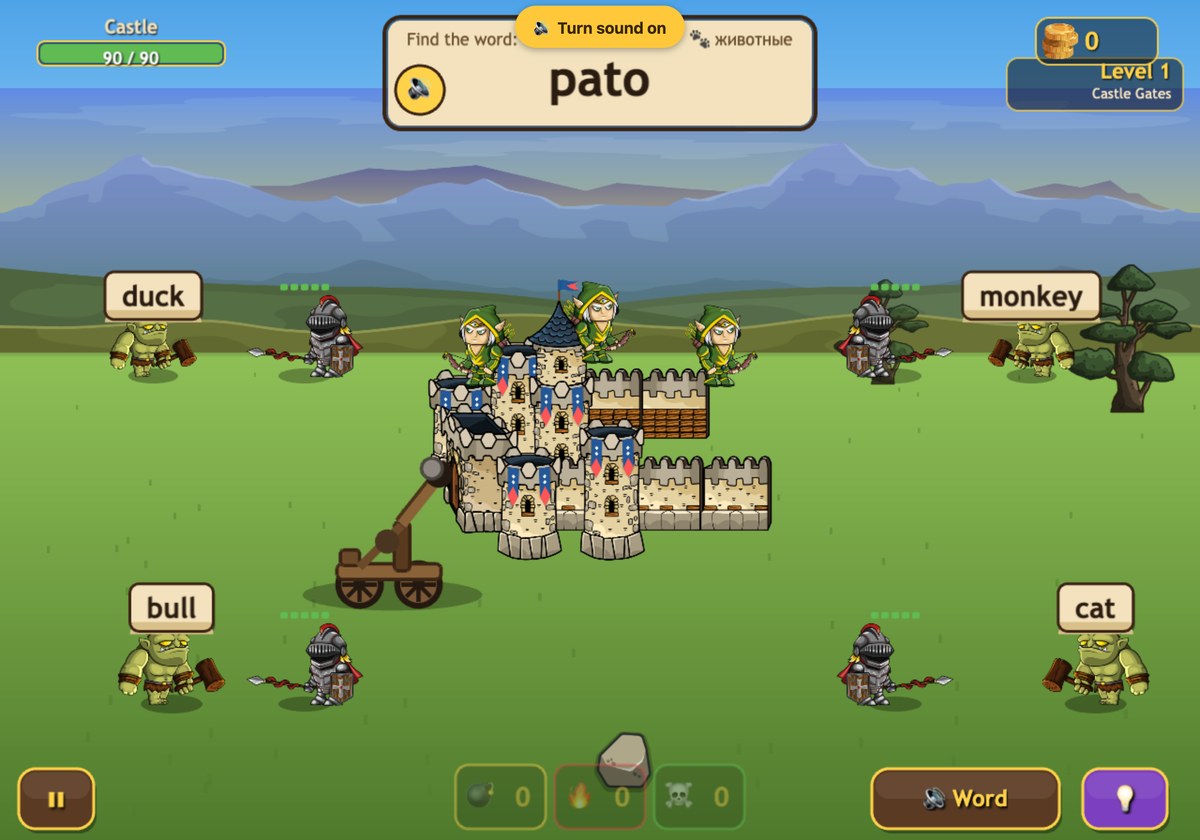
This Spanish words game for kids teaches first vocabulary through play instead of flashcards. A Spanish word appears at the top, monsters carrying possible English meanings march toward your castle, and your child taps the monster with the correct translation — the knight strikes and the walls hold.
How the game works
It's a tower-defense game: a correct answer fires the catapult and saves the castle, a wrong one lets a monster through. Each word sticks through quick recognition and a small win — no rote drilling.
1,000 words across five worlds
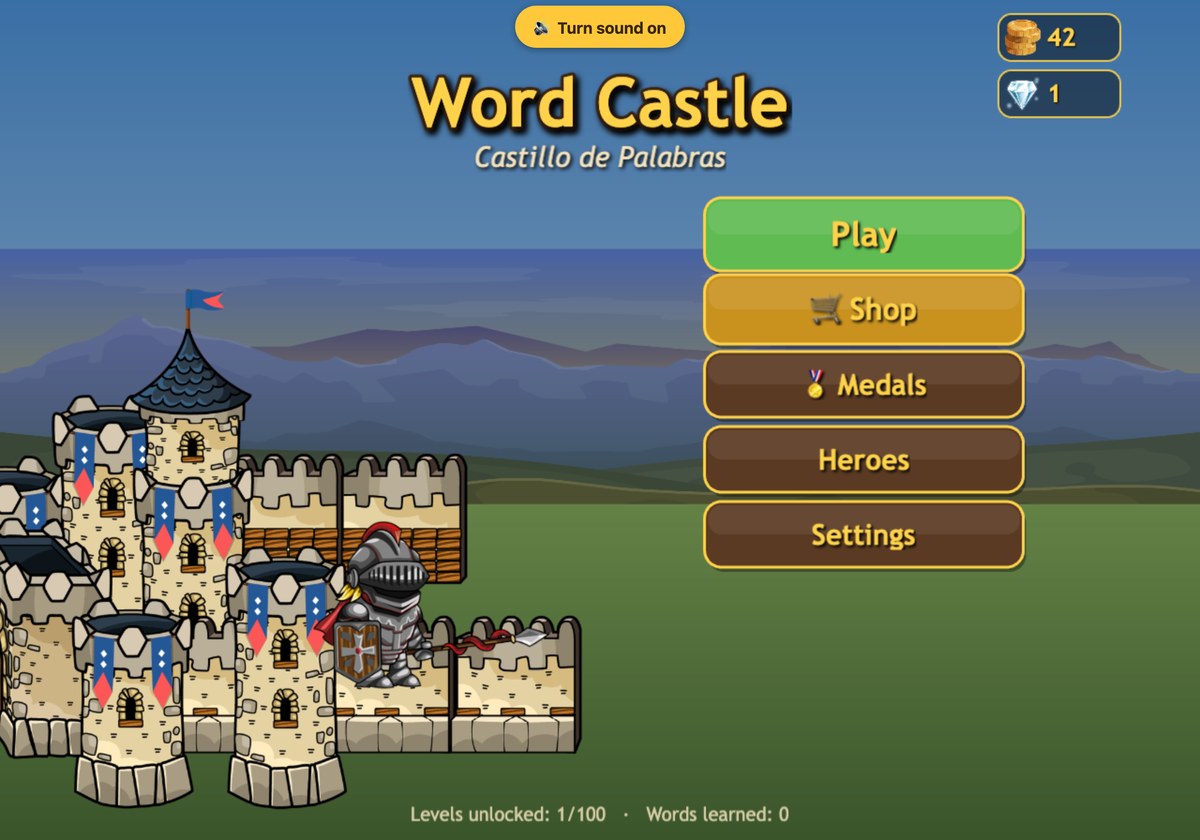
The game covers 1,000 of the most useful Spanish words across 100 levels and five themed worlds — greetings, colors, numbers, animals, food and more — building from easy to harder.
Audio and hints
Every word is spoken aloud and paired with a picture, and a friendly fairy offers a hint when your child is stuck. No prior Spanish is needed.
What Spanish words to learn first
Start with the words children use every day: greetings hola (hi) and gracias (thank you), sí (yes) and no, numbers 1–10, colors and animals — exactly where the first levels begin.
How to play
Listen to or read the Spanish word at the top. Monsters approach carrying English translations — tap the monster with the correct one to fire the catapult and defeat it. A correct answer defends the castle; a wrong one lets the monster strike. Clear the wave to finish the level and learn the next words.
What your child learns
Builds and reinforces core Spanish vocabulary — greetings, colors, numbers, animals and everyday words — through quick recognition, listening and recall.
The science behind the games
Every Dad4Kids game is built on one simple truth: children want to play, not study — so we turn learning into a game worth replaying. The method draws on peer-reviewed research in game-based learning, motivation, and how memory works.
- Chen et al. (2016). The effectiveness of digital game-based vocabulary learning: a framework-based view. British Journal of Educational Technology.
- Sundqvist (2019). Commercial-off-the-shelf games in the digital wild and L2 learner vocabulary. Language Learning & Technology.
- Nakata (2015). Effects of expanding and equal spacing on second language vocabulary learning. Studies in Second Language Acquisition.
- Nakata & Webb (2016). Does studying vocabulary in smaller sets increase learning?. Studies in Second Language Acquisition.
- Tokac et al. (2019). Effects of game-based learning on students' mathematics achievement: A meta-analysis. Journal of Computer Assisted Learning.
- Alotaibi (2024). Game-based learning in early childhood education: a systematic review and meta-analysis. Frontiers in Psychology.
FAQ
What Spanish words should kids learn first?
Start with greetings (hola, gracias), sí/no, numbers 1–10, colors and animals — the most common first words, and exactly where the game's early levels begin.
What's the best way for kids to learn Spanish words?
Short, frequent sessions that pair each word with a picture and its sound, then ask the child to recognise it fast. That's the loop here — see the word, hear it, pick the right meaning.
How many Spanish words will my child learn?
Up to 1,000 of the most useful first words, grouped by theme across 100 levels and five worlds — greetings, colors, numbers, animals, food and more.
How do you say hello in Spanish?
Hello is hola (the h is silent, so it sounds like “OH-lah”), and thank you is gracias. Both appear early in the game with audio.
Do they need to know any Spanish to start?
No. Every word has a picture and audio, so complete beginners can start at level one and build up naturally.
More free games for kids
By Evgeny Arsentiev, PhD · Last updated: June 2026